
Happy New Year, warriors! As we step into this new year, my mission remains the same: empowering service members and veterans like you get a tight seal on your health and quality of life. If you've been feeling the weight of being stuck in survival-go-mode, know this—thriving isn't about quick fixes or magic pills. It's about consistent, intentional actions that rebuild your foundation from the ground up.
Today, I'm pulling straight from the Optimal Response Initiative’s (ORI) Intensive Track Thriving Training (ITTT) Workbook for Vets: the "Health Tanks" system. Think of these as your personal fuel stations—Physical, Cognitive, Emotional, Spiritual/Nature, Social, Creative, Music, Sleep, and Reserve. Each tank targets a key area impacted by stress, backed by solid research. The goal? Set long-term destinations that take real effort, then power them with daily "fuel" tasks—simple, doable action steps you commit to every day.
Whether you're dealing with stress, fogged thinking, emotional rollercoasters, or just that nagging sense of disconnection, these tanks are your roadmap. Let's dive in and get you fueled for 2026. Remember, small steps compound into massive momentum. You've got this!
Physical Health Tank: Rev Up Your Body's Engine
Purpose: Boost vitality, dial down stress, and aid recovery from daily stress or extraordinary stress such as Post Traumatic Stess (PTS)'s physical grind (Yehuda et al., 2015). Aim for goals like shedding 10 pounds, stabilizing blood pressure, or building muscle tone.
Your Long-Term Destination Goal: [Space for you to fill in—e.g., "Achieve consistent cardiovascular health through daily movement."]
Daily Fuel (Pick 2): Choose realistic rituals like hydrating with 5-8 bottles of water (40-64 oz), a 15-minute walk, or swapping chips for carrot sticks.
Fuel Ideas to Get Started:
Drink plenty of water daily.
Take a short walk in your neighborhood.
Prep healthy meals ahead.
Stretch or do yoga for 10 minutes.
Soak up sunlight outdoors for vitamin D.
Practice deep belly breathing.
Walk your pet or dance to a tune.
Bike ride, bodyweight workouts, or even organizing a drawer—these all count!
Commit to these, and watch your body respond with more energy and less tension.
Cognitive Health Tank: Sharpen Your Mental Edge
Purpose: Clear brain fog, break negative thought cycles, and boost self-awareness to tackle PTS distortions (Frewen & Lanius, 2015). Goals might include curbing negative self-talk or improving thought-emotion links.
Your Long-Term Destination Goal: [Your turn—e.g., "Reduce extreme thoughts by pivoting to balanced alternatives."]
Daily Fuel (Pick 2): Journal thoughts for 5-10 minutes or spot one extreme idea and reframe it.
Fuel Ideas:
Morning or evening journaling.
Read a motivational quote or book snippet.
Learn a new word and use it.
Reflect on themes like resilience.
Listen to a growth podcast.
Practice mindfulness or brain games.
Write affirmations or a to-do list.
Watch a TED Talk on leadership.
These habits rewire your mind for clarity and positivity.
Emotional Health Tank: Harness Emotions as Your Allies
Purpose: Heighten awareness and resilience, using feelings as signals to meet needs and ease PTS reactivity (LeDoux, 2015). Target reducing painful emotions while amplifying joy.
Your Long-Term Destination Goal: [E.g., "Identify and address emotional needs daily."]
Daily Fuel (Pick 2): Use an emotions wheel to name feelings or do a quick SIT Rep (Situation Report): "What do I feel? What do I need?"
Fuel Ideas:
Name emotions with a wheel tool.
Journal or practice NSDR (Non-Sleep Deep Rest).
List gratitudes or listen to uplifting music.
Self-kindness acts like a warm bath.
Body scans or sharing feelings with trusted folks.
Reflect on emotion purposes (e.g., anger signals boundaries).
Embrace all emotions—they're intel, not enemies.
Spiritual/Nature Health Tank: Connect to Something Bigger
Purpose: Cultivate peace through nature or faith, combating PTS isolation (Pargament, 2007). Goals: More time outdoors or deeper practices for connection.
Your Long-Term Destination Goal: [E.g., "Feel more at ease in daily life."]
Daily Fuel (Pick 2): Sit outside noticing senses or meditate/pray for 5 minutes.
Fuel Ideas:
Sensory nature sits.
Meditation, prayer, or spiritual reading.
Journal on concepts like peace.
Meditative walks or nature sounds.
Reflect on awe moments or gratitude in nature.
Create nature art or explore spiritual values.
This tank grounds you in purpose beyond the daily grind.
Social Health Tank: Strengthen Your Squad
Purpose: Forge strong bonds—the #1 PTS recovery booster (Schnurr et al., 2020). Focus on boundaries and communication.
Your Long-Term Destination Goal: [E.g., "Build healthier relationships."]
Daily Fuel (Pick 2): Text a kind message or research a vet group.
Fuel Ideas:
Kind texts or quick calls.
Quiet time with loved ones.
Neighbor interactions or volunteering.
Share songs/memes or plan meet-ups.
Practice "no" to unhealthy vibes.
Reflect on positive social moments.
Connection is your superpower—lean into it.
Creative Health Tank: Ignite Innovation
Purpose: Foster flexibility to shatter PTS rigidity (Ben-Shachar et al., 2021). Build creative habits for problem-solving.
Your Long-Term Destination Goal: [E.g., "Complete a personal project."]
Daily Fuel (Pick 2): Doodle or write a short poem.
Fuel Ideas:
Sketching or brainstorming.
Crafts, vision boards, or recipe tweaks.
Word play or photography.
Playlists or repurposing items.
Reach out to Operation Song: https://www.operationsong.org/ “Bringing them back one song at a time.”
Unleash your inner creator for fresh perspectives.
Music Health Tank: Tune In for Regulation
Purpose: Leverage music for stress relief and mood balance (Landis-Shack et al., 2017). Two songs a day keeps Dr. Seymour away.
Your Long-Term Destination Goal: [E.g., "Use music daily for motivation."]
Daily Fuel (Pick 2): Listen actively or practice an instrument.
Fuel Ideas:
New songs or singing along.
Instrument practice or dancing.
Lyric analysis or playlists.
Tutorials or rhythmic taps.
Reach out to Operation Song: https://www.operationsong.org/ “Bringing them back one song at a time.”
Music heals—make it your daily rhythm.
Sleep Health Tank: Recharge for Real
Purpose: Optimize rest to clear fog, consolidate gains, and break PTS loops (Walker, 2017). Aim for 7-8 consistent hours.
Your Long-Term Destination Goal: [E.g., "Establish steady sleep patterns."]
Daily Fuel (Pick 2): Morning sunlight or consistent bedtimes.
Fuel Ideas:
Sunlight exposure post-wake.
No caffeine late; dim lights pre-bed.
Breathing exercises or grounding.
Cool room, no heavy meals.
Wind-down routines or sleep tracking.
Quality sleep is your secret weapon.
Reserve Health Tank: Build Your Buffer
Purpose: Proactive habits for resilience, avoiding burnout (McGonigal, 2015).
Your Long-Term Destination Goal: [E.g., "Maintain balance under stress."]
Daily Fuel (Pick 2): Breathing or gratitude journaling.
Fuel Ideas:
Body scans or fresh air breaks.
Small wins lists or self-compassion.
Stretches, teas, or affirmations.
Grounding exercises.
Stay steady, not reactive.
Bonus: Optimal Gratitude Practice – Your Ultimate Fuel Boost
Inspired by Dr. Andrew Huberman's podcast, this 1-5 minute ritual supercharges your brain, heart, and immunity. Find a story of someone helping someone else overcome a situation or struggle, write a sentence or two to summarize the interaction, then name the emotions it stirs. Re-read your notes daily for reduced anxiety, lower inflammation, and a quieter fear center (Fox et al., 2015; Hazlett et al., 2021). This simple actionable tool is science-backed and the optimal effects are immediate—try it!
How to Fuel Your Tanks Like a Pro
Set Goals: Specific, value-aligned long-terms for each tank.
Daily Fuel: Two tasks per tank, every day—no excuses.
Track It: Journal weekly, reflect on progress.
Breathe Through It: Pair with diaphragmatic breathing for extra power.
Balance Extremes: Use the Optimal Continuum to pivot from overdoing to optimal.
Practice Now: Take three deep breaths—to recalibrate your survival response and activate your thriving response.
Why This Matters for Vets with PTS
Neuroplasticity rewires your brain (Davidson & Dahl, 2018). Momentum from small habits builds thriving (Seligman, 2006). Empowerment counters helplessness (Foa et al., 2018). Holistic balance ensures nothing's overlooked (Schnurr et al., 2020).
Movement is Key: Behavior First, Always
No shortcuts here—behavior trumps medication-only fixes. Commercials promising miracle results are Blue Falcons? Buyer beware. Everay day stress or extraordinary stress such as PTS needs action: nutrition, movement, connections—not just pills that mask issues and bring side effects (National Center for PTSD, 2024). Meds have a place if informed and helpful, but over-reliance ignores roots (Goldacre, 2013). ORI prioritizes training to THRIVE and respond optimally vs. knee jerk-reacting (or believing in folk-lore like Santa Clause or quick-fixes).
Behavior harnesses neuroplasticity for real change, empowers you, and sustains recovery. Address extremes (isolation, overworking) with optimal pivots. Emotions (aka Emotes: energy in motion) are intel, moving up and out to give you info about what you may need—name them, figure out what they are telling you that you need, and brainstrom OPTIMAL ways to meet those needs via ORI SIT Reps.
Your Plan: Prioritize behaviors, engage support, track progress. No quick fixes, but the truth sets you free.
Wrapping Up: Let's Thrive in 2026
ORI Health Tanks are your daily blueprint for thriving through ordinary and extraordinary stress. Commit to these actions, and you'll build balance, purpose, and strength. You're not alone—together we are stronger; together we THRIVE.
Got a tight seal? Got fuel?
Let's G-O-O-O-O-O-O-O.
Love, Dr. S
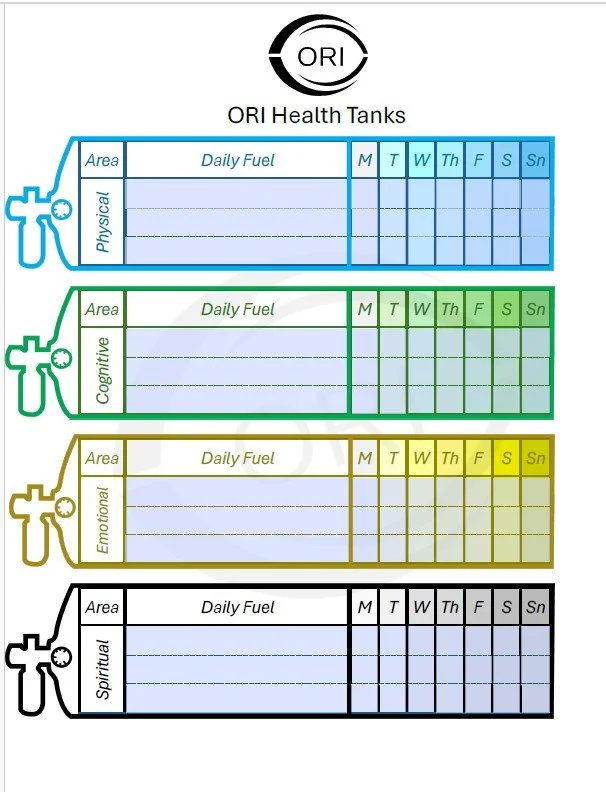
Here’s a downloadable fillable ORI Health Tanks Fuel Tracker
Choosing to fuel up is like showing up to formation; it’s not about if you feel like doing it, it’s because you are committed to the mission.
References
Ben-Shachar, M., et al. (2021). Title related to rigid thought patterns in PTSD. Publisher.
Davidson, R. J., & Dahl, C. J. (2018). Outstanding questions in meditation research. Nature Reviews Neuroscience.
Department of Veterans Affairs. (2016). VA/DoD clinical practice guideline for the management of posttraumatic stress disorder.
Foa, E. B., et al. (2018). Prolonged exposure therapy for PTSD in military veterans. Journal of Consulting and Clinical Psychology.
Fox, G. R., et al. (2015). Neural correlates of gratitude. Frontiers in Psychology, 6, Article 1491.
Frewen, P. A., & Lanius, R. A. (2015). Trauma-related altered states of consciousness: Exploring the 4-D model. Publisher.
Goldacre, B. (2013). Bad pharma: How drug companies mislead doctors and harm patients. Faber & Faber.
Hazlett, L. I., et al. (2021). Exploring neural mechanisms of the health benefits of gratitude in women: A randomized controlled trial. Brain, Behavior, and Immunity, 95, 444–453.
Landis-Shack, N., et al. (2017). Music therapy for posttraumatic stress in adults: A theoretical review. Psychomusicology: Music, Mind, and Brain, 27(4), 334–342.
LeDoux, J. E. (2015). Anxious: Using the brain to understand and treat fear and anxiety. Viking.
McGonigal, K. (2015). The upside of stress: Why stress is good for you, and how to get good at it. Avery.
National Center for PTSD. (2024). PTSD treatment guidelines and resources. U.S. Department of Veterans Affairs.
Pargament, K. I. (2007). Spiritually integrated psychotherapy: Understanding and addressing the sacred. Guilford Press.
Schnurr, P. P., et al. (2020). Social support as predictor of PTSD recovery. Journal of Traumatic Stress.
Seligman, M. E. P. (2006). Learned optimism: How to change your mind and your life. Vintage Books. (Note: Often cited for positive psychology and habits.)
Walker, M. (2017). Why we sleep: Unlocking the power of sleep and dreams. Scribner.
Yehuda, R., et al. (2015). Post-traumatic stress disorder. Nature Reviews Disease Primers, 1, Article 15057.


